
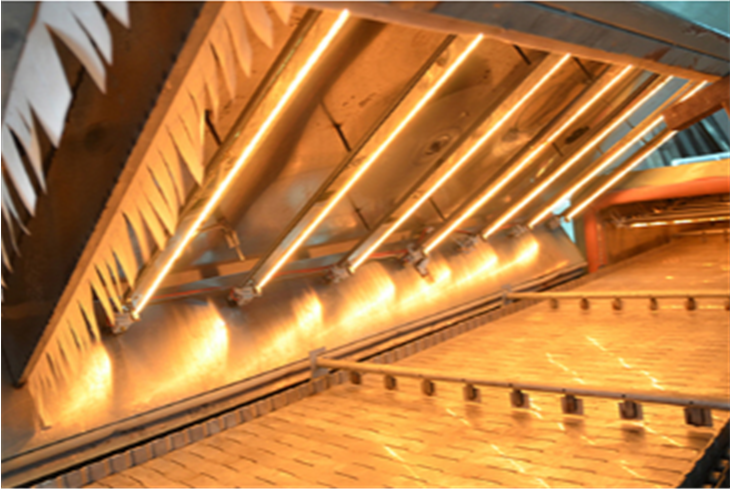
Stand on a busy bake line and watch what really eats into your margins. It isn’t just flour or labor. It’s the minutes burned waiting for the oven to climb back to setpoint after the door swings. It’s the loaves that come out pale on the outside and gummy in the middle because the heat profile drifts. It’s the energy that keeps running long after the rush should be done. Clear quartz infrared heaters, paired with convection air movement, go after those losses where they live—inside the baking chamber. The aim is straightforward: recover fast, hold steady, and spread heat so evenly that every tray looks the same.
What actually matters under the hood
A quartz IR heater isn’t just “a hot element.” It’s a radiant source that dumps energy directly onto the dough or pan surface, instead of wasting time heating air first. In a quartz convection oven, that radiant output is teamed with forced air to balance surface browning with internal doneness. The quartz tube itself is built for thermal shock duty. It heats fast and cools fast, which is exactly what a high-turnover kitchen needs when doors open and close. Wavelength matters. Short-wave IR penetrates more aggressively and responds almost instantly; medium-wave sits in a sweet spot for many bakery items, giving strong surface response without over-penetrating. We match the emitter spectrum to the product load—never the other way around. Convection does the rest. Fans move air through the chamber so heat isn’t “hot here, cold there” near the heater and in the corners. The result is a more uniform baking environment, where top-to-bottom and front-to-back swings shrink. In practice, you get two solid wins:
- **Fast recovery.**After a door cycle, the chamber comes back to setpoint faster because the IR source re-radiates immediately and the convection system redistributes that heat quickly.
- **Tighter control.**With less temperature swing, you spend less time chasing the thermostat and more time running consistent bakes.
Why this works in a real commercial kitchen
No one uses a commercial oven the way a home cook does. Doors slam. Cold pans go in. Proofed dough hits the stone hearth and releases moisture. Sheet pans stack and shadow each other. If the oven can’t keep up, you pay—in product quality and in labor. Quartz IR convection helps on both counts.
Better uniformity across the load
Radiant heat cuts the “edge effect” that shows up as over-colored edges and under-colored centers. Convection air evens out the chamber so trays on the left and right finish together. In deck ovens, that means more consistent crust color across the whole stone. In rack ovens, it means fewer reworked trays because the top rack didn’t burn while the bottom lagged.
Texture you can count on: crisp outside, tender inside
Browning isn’t just looks—it’s flavor chemistry. Caramelization and Maillard reactions need surface heat delivered at the right moment. Infrared gives you that immediate surface response, while convection airflow carries heat into the interior more evenly. For bread, that’s a crisp crust and an open, even crumb. For pastries and cookies, it means controlled spread and set—no scorched edges and pale centers.
Speed that matches the rush
When the rush hits, the oven has to be ready immediately. Quartz IR elements come up to temperature fast, and the radiant-plus-convective combo stabilizes the baking chamber quicker than conventional approaches. That cuts the wait between loads and shortens bake windows, so you keep pace without having to run the oven hotter than necessary.
Energy use that doesn’t run away on you
Faster recovery and shorter bake times reduce total energy per bake cycle. Because the element heats on demand and cools quickly when idle, you’re not holding a big thermal mass at full temperature when the line slows. That matters when energy costs are tracked per bake day, not per month.
The things you need to plan for
Quartz IR convection ovens are straightforward, but they still need real-world setup. **Installation and electrical.**These ovens draw serious current, and the heaters need proper mounting clearances and ventilation. The oven has to be wired to match the element load and controller requirements. If you’re retrofitting an existing deck or rack oven, verify panel capacity, connector type, and physical space before you order. **Compatibility with your bake program.**Infrared responds fast, and that can be too much for delicate items if the controller isn’t set carefully. Thin-crust pizzas, certain laminated pastries, and sugar-heavy toppings can overshoot with an aggressive setpoint. The fix isn’t to avoid IR—it’s to tune the profile. Use lower peak settings, adjust airflow, and let the controller balance radiant and convective heat. **Maintenance.**Quartz tubes are tough, but they aren’t indestructible. Handle them by the ends, keep them clean of grease and batter splatter, and watch for hot spots or discoloration. Replace tubes before they fail—keep a spare set on hand so you don’t lose a service window. If your current oven is giving you uneven color, long recovery times, and inconsistent texture across trays, the problem isn’t your recipe. It’s how heat is being delivered. A clear quartz IR heater integrated into a convection baking chamber gives you the speed and control needed to run repeatable bakes at volume—without giving up crust, crumb, or color.