
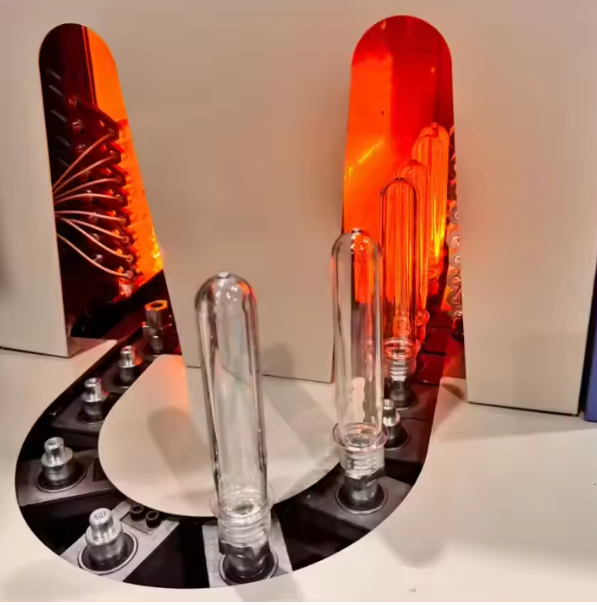
On a SIPA stretch blow molding line, the heating tunnel is where the shift gets won or lost. Run the preforms too cold, and you’re fighting thin walls and weak bottle strength. Run them too hot, and you’ll see crystallization and gloss issues. Either way, the line slows down, scrap climbs, and the energy draw keeps ticking up. Most of the time, the culprit isn’t the blow molder. It’s the heating lamp inside that tunnel—old, drifting, and no longer doing its job. Swap it for a lamp that doesn’t match the original thermal profile, and you’ll pay for it in cycle time, scrap, and downtime. We supply SIPA preform heating lamps wholesale as direct-fit infrared emitters built for the SIPA heating zone. The aim is straightforward: put the heating performance back where it should be, then keep it stable shift after shift.
What matters, technically
SIPA preform heating lamps aren’t generic bulbs. They’re a matched set—emitter, reflector, and interface—so the heat lands on the preform exactly the way the machine was designed to run. We build the emitter around short-wave infrared (IR) halogen technology. The quartz envelope delivers high-intensity IR fast, and the internal filament responds quickly when the heating zone calls for power. In practice, preforms come up to temperature fast, and the control system can correct quickly when ambient conditions change. Here are the specs plant engineers actually care about:
- **Wavelength:**Short-wave IR for rapid, surface-efficient heating—fast enough for high-cavity cycle rates without overshoot.
- **Power density and output stability:**Consistent radiant output across the lamp life, so the heating profile doesn’t drift and force constant retuning of the tunnel.
- **Mechanical interface:**Direct-fit mounting and connector compatibility, typically using an R7s base and dimensions that match the OEM lamp footprint.
- **Voltage and tolerance:**Specified to match your SIPA machine’s supply, with tight tolerances so the power supply doesn’t see spikes or uneven loading.
- **Reflector geometry:**Controlled beam pattern to concentrate energy on the preform shoulder and body, cutting wasted heat and improving temperature uniformity. This is where the details matter. A lamp that’s too long hits the mounting clips. A wrong base leads to adapters that create hot spots and poor contact. Wrong wattage makes the PID loop hunt and the heating band go inconsistent. Our lamps are dimensioned and wired to fit the SIPA heating tunnel as a true replacement part, not a workaround.
Why this matters on a SIPA blow molding line
In stretch blow molding, the heating tunnel is the bottleneck you can’t hide. Preforms have to hit the right temperature profile before they hit the mold. Underheated, and blow pressure climbs, cycle time stretches, and you start seeing splits and stress marks. Overheated, and you get crystallized necks, haze, and weaker material. A matched infrared lamp fixes the two things that cost you the most: consistency and uptime.
Consistency that cuts scrap
With a properly matched lamp, the heating curve behaves predictably. The preform surface heats quickly, the interior equalizes, and the temperature spread stays within the window your process needs. That means fewer rejects from uneven wall thickness, fewer pressure-related failures, and fewer cosmetic defects driven by thermal stress. When plants switch to a matched lamp, scrap typically drops because the heating zone stops fighting itself. The tunnel doesn’t need constant retuning to cover for a weak lamp.
Uptime that comes from fewer interruptions
Aging lamps don’t just go dark. They lose output, drift out of spec, and make the heating zone harder to control. That forces operators to slow the line, tweak offsets, and run extra samples. A direct-fit infrared replacement restores the designed heating response. Fewer stops for temperature issues, fewer mid-run adjustments, and a line that holds its cycle rate.
Energy and cost savings you can actually track
Infrared heating is efficient because it delivers heat directly to the preform, not the surrounding air. Replace an old lamp with a properly specified emitter, and you cut wasted heat and improve the power-to-temperature response. Over a year, the savings show up in three places:
- **Lower energy use:**Shorter warm-up, faster stabilization, and less excess heat bleeding into the machine frame and surroundings.
- **Fewer lamp purchases:**Replacement intervals stretch when you stop running mismatched parts that burn out early.
- **More bottles per hour:**When the heating tunnel holds its setpoint, the line runs closer to its rated output. On a typical SIPA line running high-volume PET, we’ve seen plants reduce heating-related scrap by measurable margins and cut heating-zone energy spend by double-digit percentages after switching to matched emitters. Your exact numbers depend on the age of the existing lamps, cavity count, and bottle design, but the direction is consistent: better thermal control lowers cost per bottle.
What to watch for before you swap
Even a good lamp needs a clean install and the right conditions. Here’s what we tell the maintenance team every time.
- **Confirm the exact lamp code.**SIPA machines can use different wattages and lengths depending on model and cavity count. Match the lamp to the machine’s specified code, not just the nameplate.
- **Check the reflector condition.**A scratched or oxidized reflector throws the beam off and creates uneven heating. If it’s pitted, replace it when you replace the lamp.
- **Inspect the socket and wiring.**High heat bakes connectors. Look for discoloration, brittle insulation, and loose contacts. A bad socket causes voltage drop and shortens lamp life.
- **Handle with clean, dry gloves.**Skin oils create hot spots on the quartz envelope. Wiping won’t fix it—just don’t touch the lamp.
- **Set the lamp position correctly.**Too close, and you risk overheating the preform surface. Too far, and you chase temperature and lose cycle speed. Use the original spacing marks or the machine manual.
- **Expect a short break-in period.**New lamps stabilize over the first few hours. Let the heating zone retune, then lock in the settings. One real-world constraint: infrared lamps don’t like repeated thermal shock. If your line stops and starts frequently, the lamp sees repeated heat-up and cool-down cycles, which adds stress. In those environments, pair the lamp with disciplined process control—minimize unnecessary stops and keep the heating zone temperature stable during changeovers. If your SIPA blow molder is running slower than it should, and the heating tunnel keeps forcing you to choose between speed and quality, the answer may be one lamp away. Spec the right replacement, install it clean, and you get a heating zone that behaves like it should—predictable, stable, and cost-aware. Need a wholesale quote for SIPA preform heating lamps? Give us the machine model, cavity count, and the lamp code currently on the machine. We’ll match the interface, thermal output, and performance your line needs.