

Why getting the numbers exactly right matters for your Sidel Matrix
When we talk about infrared lamps for your Sidel Matrix blow molder, we aren’t just chasing some generic wattage rating. We’re matching the original heat pattern. The whole point is to keep the machine running the way it did on day one—no re-tuning needed. That means the PET preform gets the same heat-up, the same time in the hot zone, and the same energy level as the original setup. Our lamps are built as straight swaps. Same voltage, same power, same size. So your controls and sensors keep reading everything the way they always have. No remapping. No guesswork. Pull the old lamp, wire in the new one, and keep the line moving.
The details that make the difference: power, voltage, and fit
These lamps are built for the reality of a PET blowing plant: heat has to hit the preform quickly, and it has to be the same every time. So we match the Sidel Matrix specs head-on—high voltage, high wattage in a tight space, and dimensions held to a tight tolerance. The 400V input is there for a reason: it delivers serious power through a compact tube, giving you the heat flux needed for fast crystallization and stretching. The wattage is set to hold the right temperature window across the preform wall. And the length and diameter are held to exact specs so the lamp sits in the reflector exactly where it should. This is high-heat gear. It performs, but it also asks for the right environment. If your machine’s cooling or airflow isn’t where it needs to be, the lamp will run hotter than it’s meant to.
What’s inside: materials, coating, and connections
The lamp uses a quartz tube filled with halogen. The halogen chemistry helps keep the filament stable and fights the usual blackening over time, so output stays consistent shift after shift. Quartz handles big temperature swings and won’t crack when the lamp cycles on and off fast. A special reflective coating on the tube pushes more IR energy forward, so less heat is wasted and more goes into the preform. It also helps keep the surface temperature even along the hot zone. For the ends, we use an R7s-type connector. It’s made for high current and high temperature, with contact pressure that stays solid. It installs quickly and stays tight even with vibration, so you don’t have to worry about arcing or hot spots at the connections.
On the floor: PET blowing with the Sidel Matrix
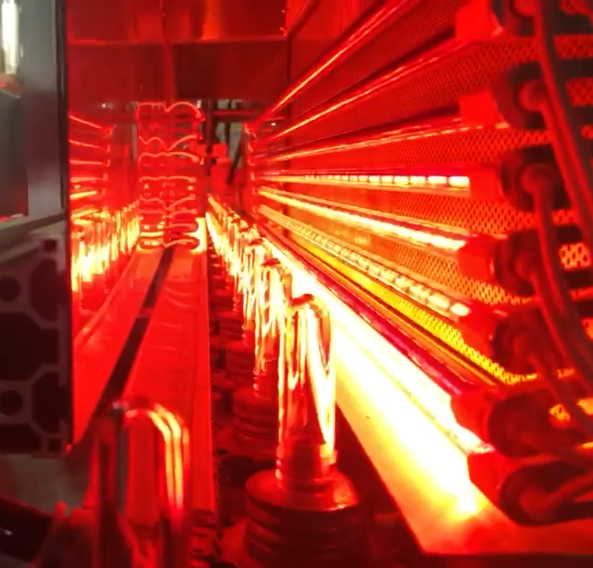
In Sidel Matrix blow molding, IR heating is what gets the PET preform ready before stretching. The lamp has to deliver predictable heat penetration, because that’s what keeps bottle wall thickness even and cycle time steady. With our lamps, you get the same heating curve as the original, which keeps your process window stable. That translates to fewer rejects from uneven heating—and less downtime spent chasing temperature settings. The R7s connection makes replacement fast, so maintenance can swap lamps without rewiring. Now, the trade-off is thermal density. High output means you need the reflector aligned and the airflow clean. Keep the lamp, reflector, and cooling in spec, and the lamp will run reliably, shift after shift.