

Every blow molder on the floor knows the real enemy: unplanned stops. The heating tunnel starts to drift, preforms come out uneven, and suddenly you’re bleeding output and paying for emergency fixes. More often than not, the heater is the weak link—aged quartz elements, emitters that don’t match the profile, connectors that don’t really lock in. We built our PETC blow molding spare parts heater line to fix that, specifically for stretch blow molding on Sidel, Krones, SIPA, Husky, SACMI, and Nissei ASB machines.
What matters technically
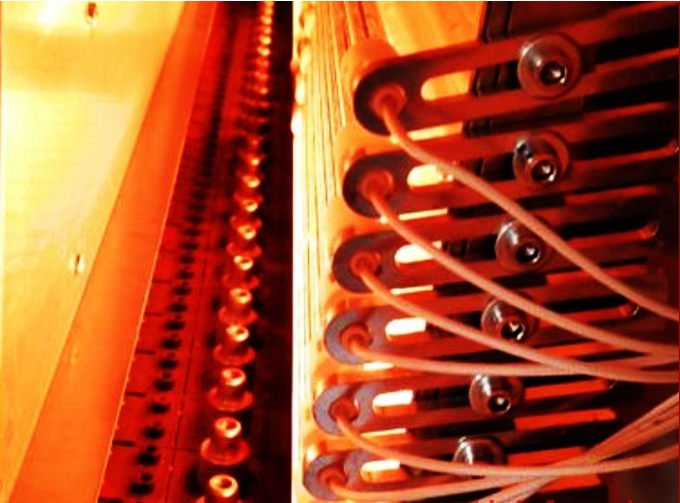
We match the OEM thermal behavior with short-wave infrared emitters engineered around your preform heating profile. You can spec halogen quartz or high-stability infrared elements, with power that lines up to the original machine zones: 1.5 kW to 3.0 kW, 220–240 V, and standard R7s connectors. The quartz tube geometry and mounting dimensions are 1:1 to the OEM footprint, so the emitter drops in without tweaking brackets or rewiring. Response is fast, and the spectral output targets the PET absorption band, so heating across the preform wall stays repeatable.
Why it holds up on the line
After a changeover, you get a quicker warm-up, and under 24/7 schedules the heating stays stable. That means fewer temperature swings, better bottle quality, and fewer rejects. Energy use drops because the emitter heats on demand and holds setpoint without overshoot. Replacement intervals stretch out, so your spare inventory shrinks and maintenance labor eases up. The payoff is uptime you can count on and a cost per bottle that doesn’t jump around.
The details that keep you out of trouble
Plug-and-play only works when reflector alignment and airflow match your machine’s tunnel. Verify voltage at the terminal, confirm the connector type, and check clearance around the quartz tube to avoid hot spots. These emitters run hot, so keep cooling steady and the setup clean. If you run high-cavitation or heavy-weight bottles, give us the exact machine model and zone layout—we’ll set the power density to match the duty cycle.